
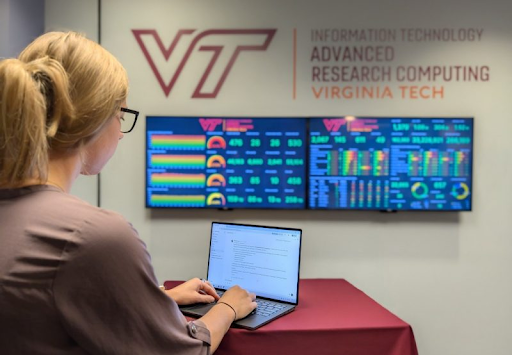
As we enter the spring season and the final quarter, we recently experienced Ivy Day and many other decision dates. Just a few months ago, your favorite seniors were locked in their rooms, finishing up their early decision apps, and nervously awaiting a response. Then come to find out that one senior you’ve only seen in Lex, got into their dream school! However, have you ever stopped to think, maybe they got in because of AI? Some big name colleges, for example, Virginia Tech, have reportedly integrated AI in their admission processes.
I recently talked to Juan P. Espinoza, Vice Provost for Enrollment Management at Virginia Tech, to get a closer insight into their AI use in relation to applications.
As per an LA Times article, Virginia Tech is using AI in order to more efficiently look over and “score” college application essays. If you applied to Virginia Tech last year, your essay was read and scored between zero and 12 by two human readers. If there was a disagreement between the two scores by four or more points, a third reader would provide their input. With the AI integration this year, the discrepancy gap shortened to two points. Mr. Espinoza explained this change was made to ensure “that the AI tool was not disagreeing at a higher rate than two humans would be disagreeing.”
When looking through application essays, Virginia Tech prioritizes how prepared a student is for college. This includes looking for how well “students set goals, pursue goals, and achieve goals.” In fact, Mr. Espinoza mentioned a study that proved that GPA, grades, and taking advanced classes directly correlate to a student’s readiness for college. So, Virginia Tech’s essays look for the side of students that doesn’t include statistics but relates to their capability to succeed. The rubric for the AI reflects this, looking for “non-academic, non-cognitive factors–not only how [students] are gonna do in college, but how they’re gonna do in life.”
In order to pacify any worry that may come from AI judging a students mindset, Mr. Espinoza explained the intense development the AI went through.
Initially, the team began with a singular large-language model (LLM), which is essentially the backbone of the AI. After some modifications across 3 years, they upgraded from relying on one LLM to three. Consequently, there is a broader spectrum to grade upon and a higher level of confidence. Next, the rubric was applied and the AI was coached with hundreds of thousands of essays from the past seven admission cycles. Mr. Espinoza described the process as, “a trial and error on different levels.”
Mr. Espinoza made a case for the many benefits of using AI in admission processes. “We get about fifty-eight thousand applications. If you think about four essays, and each essay requiring two human reads, it’s about five hundred thousand essays in total that need to be read,” he explained. Using AI has reportedly lessened the time taken to comb through all essays by 8,000 hours, which allowed Virginia Tech to release early action decisions over a month earlier than usual. Additionally, Mr. Espinoza mentioned AI’s consistency that sometimes isn’t matched by humans. While “we have bad days [and] get tired,” AI is “very, very consistent.”
To ease the doubts of those who aren’t reassured, Mr. Espinoza made it clear that Virginia Tech values transparency. Referencing their willingness to talk to media and the public about the AI use, Mr. Espinoza claimed, “We could have very easily never told the public about the use of this tool, and there’s been a couple of other institutions out there that I think that’s the case.” Mr. Espinoza shared that they plan to report back to the public with their findings of AI’s involvement in these processes, as this is the first year it has been put to use. These findings will also influence whether the AI will become a regular variable in admission methods. Although, if negative, the efficiency will be hard to beat.
The common question critics asked was: If schools condemn AI use in students’ work, how can they use AI in their own tasks? Mr. Espinoza claimed this is not the case. Instead, he encourages utilizing it for brainstorming purposes. However, he warns that if applicants decide to use it exclusively to answer essay questions, it could possibly not produce desired or accurate results with the nature of the questions being very personal.
The question remains, is AI able to measure all students’ personal responses fairly? Mr. Espinoza mentioned that the essay questions for Virginia Tech specifically aim to uproot and present applicants’ “non-cognitive factors.” This includes behavioral, social, and emotional traits. Even with the extensive research and development, AI is not known for its flexibility. Instead, it is told how to think and respond, and what to look for. This requires trust between administrators, applicants, and the AI itself. With this new addition to admissions processes, it creates a new ask of trust, one that applicants and their families may not yet be ready to answer.



Be the first to comment on "Colleges Are Using AI To Read Your Application"