
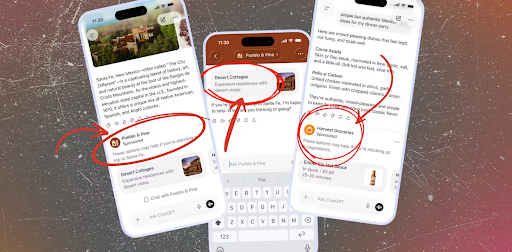
ChatGPT creator OpenAI predicts ad revenue of $2.5 billion by the end of 2025 and projects revenue of $100 billion by 2030, assuming the company’s products will reach 2.75 billion weekly users by 2030. Axios reported this prediction on April 2, citing a source connected with recent presentations to investors.
Already showing momentum, ChatGPT reached the $100 million annualized revenue mark just six weeks after its advertisement pilot program launched on January 16. The pilot program only applies to adults in the United States using either the free or Go tier, and while around 85% of ChatGPT users qualify, OpenAI chose to roll out the feature to only 20% of its user base, so roughly 16% of all users. Alongside the pilot program announcement, OpenAI published its ad principles, promising that ads do not influence ChatGPT’s answers and are separate and clearly labeled.
Ad revenue is a step in the right direction, but OpenAI’s own forecast predicts $14 billion in losses for 2026. Its advertising strategy is certainly profitable, but it relies on user base growth and not losing current customers. Analysts at Reuters worry that advertisements could irk some users and result in decreased satisfaction—a risk OpenAI downplays by self-reporting no impact on user trust. Ads could potentially disrupt workflow and hurt trust between the customer and the corporation.
Two IMSA students, Kaima Akpuokwe and Peyton Loustaunau, shared their perspectives on OpenAI’s evolving ad model. Daily user Akpuokwe said distraction was a concern: “If I saw ads consistently when I’m trying to use it to study, those would definitely distract me. I’m the type of person who studies without any distractions in my environment. So if I’m seeing ads, I might be clicking on them, to be honest, even if I don’t want the product, just out of curiosity.” Loustaunaua, a less frequent user, was less worried about advertisements being distracting, saying, “When I see ads in general, it doesn’t really impact me.”
The students generally agreed that having advertisements or sponsors related to ChatGPT’s answers makes the model less trustworthy. “If they’re willing to promote ads for specific companies, it makes me think that the information they’re giving us isn’t just general and neutral information. Obviously, it’s catering to some party,” said Akpuokwe. Loustaunau responded similarly but drew a distinction: “If the ads are put into the answers, it’s not fair. I think having it just like a normal, regular site, where there’s a pop-up ad, or two, makes it a little bit more normal and less scary.” Their responses confirm analysts’ fears that users will trust OpenAI less if the advertisements are related to answers provided by ChatGPT, but they also raise a new question: will consumers be pushed away from OpenAI products if they start featuring ads?
Both students say no. Loustaunau’s opinion was that “IMSA students already are very aware of the issues that come with AI, but there’s still quite a heavy use of it…I don’t think that ads are going to really change that mindset.” Akpuokwe agreed, explaining that AI has “just been so integrated into our culture that even if we keep seeing ads for the craziest products, we’re still going to use it.”
OpenAI may retain user trust while 16% of users see advertisements, but that loyalty may waver once the ad program expands. Social media platforms like Instagram and YouTube introduced ads gradually, and user trust eroded alongside. OpenAI’s pilot advertisement program could prove profitable if its user base grows as predicted, but as it stares down $14 billion in losses, the company is betting heavily on its ability to scale advertising without scaling away its users.





Be the first to comment on "OpenAI Introduces Ads: What It Means for Users"