
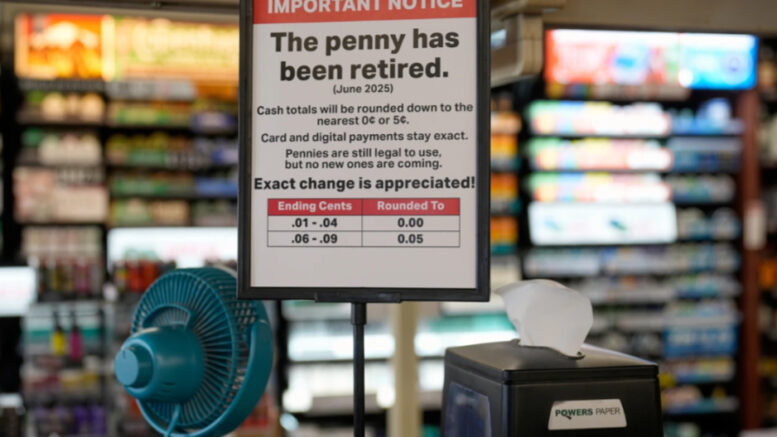
On November 12th, the last penny was minted. This penny is predicted to enter circulation in 2026, marking the end of an era lasting over 230 years. Retailers have already reported a penny shortage, with many enacting new policies to handle the issue.
Physical cash, in general, is cumbersome. It costs money to produce and transport, and it takes up significant space. Corporations have long argued for the discontinuation of the penny, but they didn’t expect it to happen so abruptly. The same day President Donald Trump re-entered office, he made an executive order creating DOGE, the Department of Government Efficiency. The White House’s official website states the department’s purpose as “modernizing Federal technology and software to maximize governmental efficiency and productivity.”
On February 9th, Trump ordered Treasury Secretary Scott Bessent to stop producing pennies and posted on Truth Social, “Let’s rip the waste out of our great nation’s budget, even if it’s a penny at a time.” But the penny may not be as trivial as the current president makes it seem. Removing the one-cent coin from circulation means that someone will have to bear the cost of rounding to the nearest nickel. Establishments can either choose to round down and bear the brunt of a few cents over millions of purchases or put the burden on customers.
Kwik Trip, a Midwest convenience store chain, predicts a company loss of roughly $3 million this year due to its decision to round down. Banks aren’t faring any better than retailers, and many have already burned through the supply they had when penny production was halted. Troy Richards, president of Louisiana-based Guaranty Bank & Trust Co., said the $1,800 in pennies they had were gone in just weeks. They are keeping small amounts of pennies for customers cashing checks, but nothing beyond that.
The United States has 5.6 million households (4.2%) that are unbanked or underbanked and rely almost exclusively on cash to complete their transactions. Removal of the penny would disproportionately impact these individuals, who are often already low-income. Rounding to the nearest nickel can take a huge toll on budgets already stretched thin.
Although ending penny minting comes with drawbacks, the financial case for discontinuing it is strong. In 2024, the U.S. minted 3.2 billion pennies worth a total of $31.7 million. Producing them costs significantly more, approximately $117 million, because each penny requires about 3.7 cents to make. Their cost of production, coupled with the fact that they made up 54% of all coins minted last year, makes pennies the Mint’s largest money-loser. The environmental cost is significant as well: discontinuation reduces zinc extraction, lowers factory energy use, and eliminates the fossil fuels required to transport billions of pennies each year.
The main issue with this ordeal is the lack of guidance from the federal government. Other countries have successfully eliminated their one-cent coins, but their transitions took years and even decades. Canada began phasing out their one-cent coin in 2013 and is still in the process today. The conversion of the British coin system from shillings to the hundred-pence-a-pound format took the majority of the 1960s and 1970s.
Many Americans do not have a problem with the end of the penny—they just disagree with how abruptly it has occurred. “We have been advocating the abolition of the penny for 30 years. But this is not the way we wanted it to go,” said Jeff Lenard with the National Association of Convenience Stores. They don’t want the penny back. They want the government to take accountability in guiding the country through a worsening penny shortage. Guiding Americans through the end of the penny isn’t complicated, but the absence of planning has turned a simple monetary change into a nationwide disruption.
Sources
https://www.npr.org/2025/05/22/nx-s1-5407493/no-more-pennies-one-cent-treasury-stop-minting
https://www.cnbc.com/2025/11/19/us-mints-final-penny.html
https://www.nytimes.com/2025/02/09/us/politics/trump-stop-minting-pennies.html
https://truthsocial.com/@realDonaldTrump/posts/113977224933701762
https://www.historic-uk.com/HistoryUK/HistoryofBritain/Decimalisation-in-Britain/





Be the first to comment on "Trump Ends Penny Production, Triggering a Nationwide Shortage"