
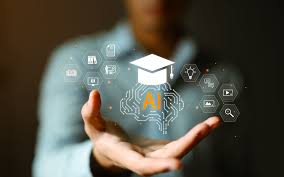
After its successful pilot last year, IMSA is to see similar success with its AI Credential program, which was re-launched this January. To learn more, I interviewed Ms. Kavithaa Kumar, a member of IMSA’s CS faculty who is working to facilitate this certification.
The AI Credential is a program that serves to introduce students to the foundations of artificial intelligence and its vast applications across different fields. Last year, this program was piloted in the spring, and saw success amongst the IMSA students who volunteered to try it. Now, the program is being launched outside of IMSA, so students from other schools will be able to complete it and potentially earn credit in their own districts.
The program will be asynchronous for the entire state, with students and educators alike completing the course. “Even our own board members have taken this course,” says Ms. Kumar. The main goal of the program is to teach AI literacy. This is accomplished through a variety of hands-on modules where students work with Scratch programming, Teachable Machine by Google, and a specialized version of Scratch by MIT that allows students to implement text classification and machine learning.
When compared to IMSA’s own Artificial Intelligence courses, AI 1 and AI 2, Ms. Kumar says there are several key differences. The first is that, unlike in these courses, the AI Credential will have little physical coding using Python. Specifically, Teachable Machine from Google is a tool where students will be able to upload datasets and automatically train a model without having to build the Python scripts themselves.
Another main difference is that while IMSA’s courses focus on the understanding and implementation of machine learning models, the main goal of the credential is for students to become familiar with the applications of AI. For instance, some of the modules include intelligent agents, natural language processing, computer vision, robotics. “Students will develop projects to figure out a use case for AI, and then figure out how different sensors or actuators can help, and the different data they need to get the agent working,” Ms. Kumar said, before explaining that at the end of the course, students will complete a capstone project dedicated entirely to the application of AI.
This program will be different from the one piloted last year. Speaking on the improvements made, Ms. Kumar said that “we reworked every single module to get a better pace, with the original having only one or two modules–the new one has eight.” Additionally, some schools have accepted the AI Credential for credit. All students will earn a certificate from IMSA upon completing the course, and in participating school districts students will be able to earn course credit.
But Ms. Kumar is not working alone. Alongside her is Ms. Marti Shirley, an IMSA alum and former IMSA Math and Computer Science faculty member, who facilitates the educator sections of the course, or the modules which are completed by educators across the state. She also helped to design three of the new modules, with Ms. Kumar creating the remaining five. But beyond that, there is also potential for IMSA students to become involved as graders for the modules that students will complete.
The AI Credential, along with previous initiatives like the AI Center, mark a new focus for IMSA on expanding its resources for artificial intelligence. Speaking on how the future will look for this expansion, Ms. Kumar explains that “we will have more courses for more specific fields of AI if students show interest,” with topics like deep learning and healthcare, natural language processing, AI sports analytics, and AI and medicine all potential focuses for new courses. While no one can predict how AI will change in the future, one thing seems certain: IMSA is determined to invest in AI.


Be the first to comment on "IMSA’s New AI Credential: What It Means"