
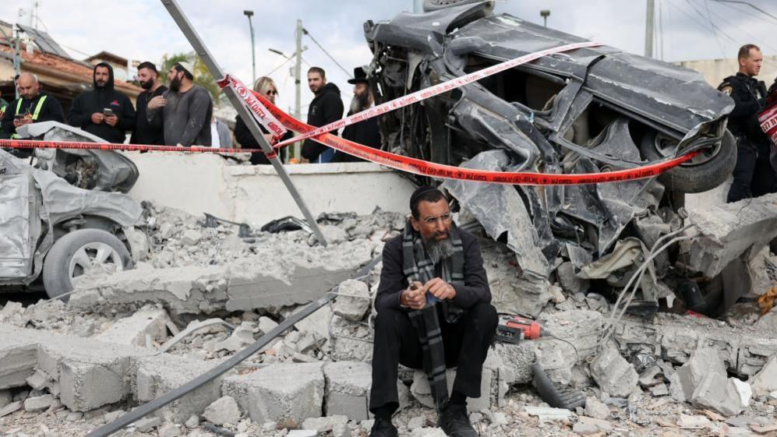
On February 28th, the United States bombed Iran, with President Trump claiming that the Middle-Eastern country was developing nuclear weapons that would be a threat to the U.S. and its allies. This action triggered war in the region, with Iran retaliating by launching its own strikes against U.S. military bases in Israel and other Middle Eastern countries.
Naturally, such a conflict has global consequences, with immediate effects like those on air travel in the region, but also longer-term effects like the price of oil and on the global economy.
Tourism and Travel
Perhaps the most immediate impact is on the tourism industry within the Middle East: figures report that international arrivals are projected to drop by 11% to 27% in 2026. This would mean that potentially up to $56 billion would be lost in visitor spending.
Moreover, cities like Dubai, Doha, and Abu Dhabi are major hubs in the region. These locations have already seen thousands of flights cancelled, yet they account for 14% of all international flight transit.
The effect is magnified in places like Dubai, where tourism is a major part of its industry. In 2023, tourism alone made up over 12 percent of the UAE’s total economy, as reported by Statista; this number would be significantly damaged after Iran’s strikes forced Dubai to close its airport temporarily before resuming operations under restriction.
While these effects would be immediately felt by travelers and those living in these major hubs, one consequence of the war would be felt by nearly every country around the globe: the price of oil.
Oil
The initial conflict pushed the price of oil to $90-100 per barrel, and some predict that the price could remain well over $100 per barrel within the upcoming months. For reference, the last time that the price of oil exceeded $100 per barrel was in 2022, when Russia invaded Ukraine.
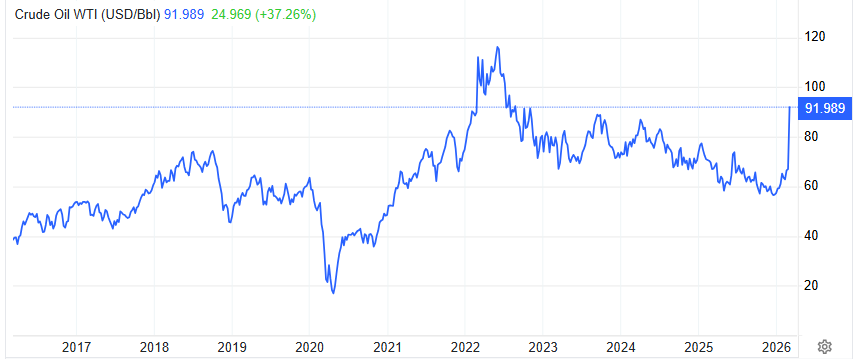
A graph showing crude oil prices per barrel. A spike is seen in early 2026 following the Iran strikes and between 2022 and 2023, when Russia invaded Ukraine. | Source: Trading Economics
The main consequence of the war that is playing into the disruption of oil prices is the control over the Strait of Hormuz. The passageway, located between the Persian Gulf and the Gulf of Oman, is strategically one of the most important choke points globally, and is considered the most critical oil artery in the world.
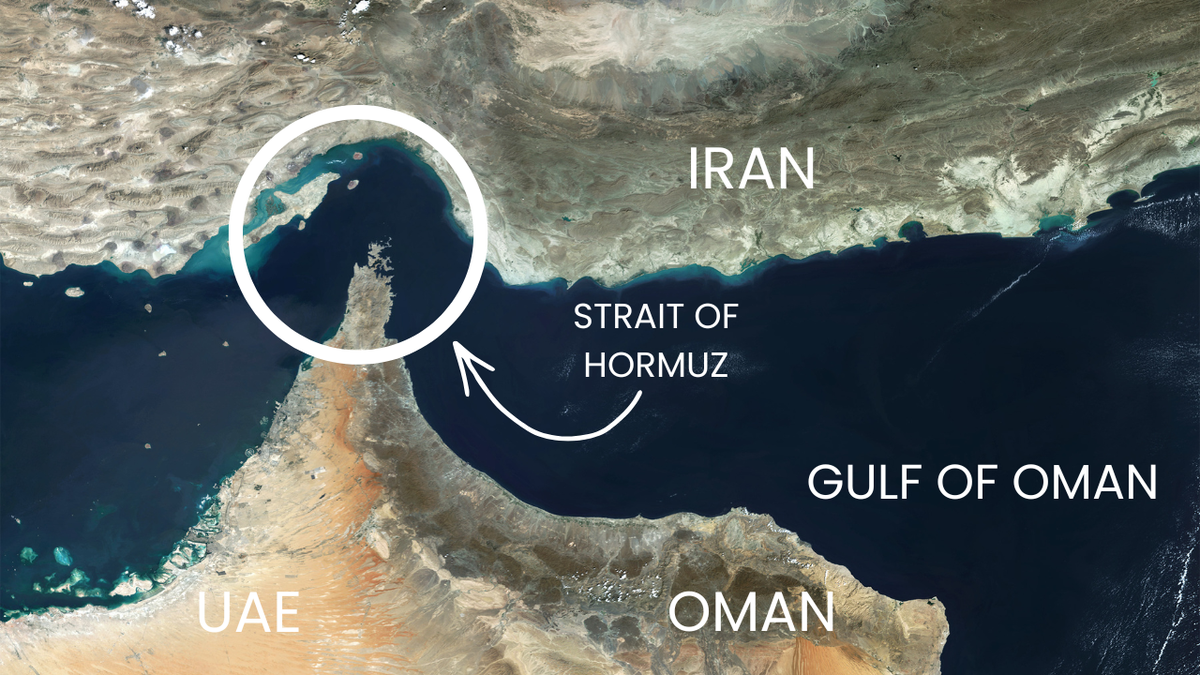
The Strait of Hormuz. | Source: Fox News
Similarly, prices of energy have been affected. QatarEnergy recently declared force majeure–a contractual clause that allows parties to be freed from liability under extreme circumstances–on its liquefied natural gas (LNG) shipments. Since the Gulf provides 20% of the world’s LNG, this consequence of the war will drive up electricity prices in Europe and Asia.
Beyond the Strait of Hormuz, the Red Sea has become unstable for global shipping operations. This has forced ships to bypass the region for the Cape of Good Hope route, adding nearly 3,500 nautical miles and roughly $1 million in fuel costs per voyage. Like previously mentioned, regional airspace is also closed or restricted, causing air freight costs for time-sensitive goods like electronics and pharmaceuticals to spike by as much as 400% in some corridors.
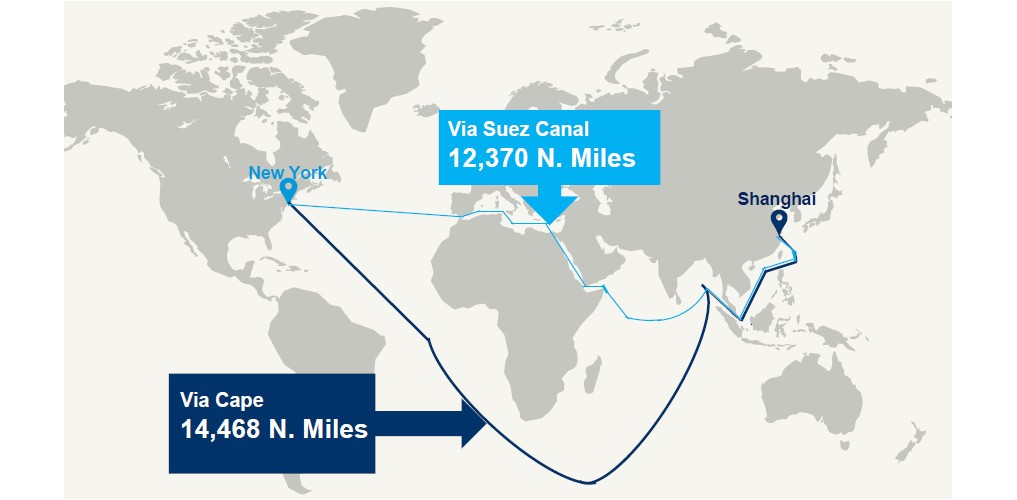
A visual comparison of the Suez Canal route, through the Mediterranean and Red seas, and the Cape of Good Hope route, which circles Africa | Source: Kuehne+Nagel
Manufacturing
Just-In-Time (JIT) manufacturing, a form of manufacturing where specialized parts are procured when they are needed rather than stockpiling large inventories, has been disrupted by the war. Deliveries for production of things like microchips and EV batteries are examples of parts of the global supply chain that have been affected. Similarly, data infrastructure was also impacted by the strikes, with Microsoft Azure and AWS investigating latency spikes in Middle Eastern nodes after the strikes on Dubai and Doha.
In India, a global hub for generic drugs, Gulf transit is relied on for ingredients. Manufacturers have thus been warned that the war will result in looming shortages for Active Pharmaceutical Ingredients (APIs). Moreover, the war will threaten nitrogen fertilizer exports with Northern Hemisphere spring planting to take place soon. This could trigger shortages in South Asia and Latin America, resulting in lower crop yields for late 2026 and increasing the cost of food.
Finance
On February 28th, trading algorithms executed mass sell orders less than a second after the first reports of strikes in Tehran. As a result, equity futures plummeted before human traders had the chance to react to the headlines. The added instability also means that investors are fleeing to defensive stocks, with gold, the U.S. dollar, utilities, healthcare, and defense/aerospace becoming more prominent.
This also makes it difficult for central banks like the Federal Reserve Board to manage interest rates. Rising energy costs will lead to greater inflation, but the conflict threatens to slow GDP growth, making it harder to decide interest rates.
Ultimately, in the global and connected world of the 21st century, when war strikes in one part of the world supply chains all around the globe are affected. Important industries like distribution, travel, and energy are all affected by the tension in the Middle East, with effects expected to continue to last, potentially leading to more consequences in the future.




Be the first to comment on "The Impact Of Iran War On Global Industry"