
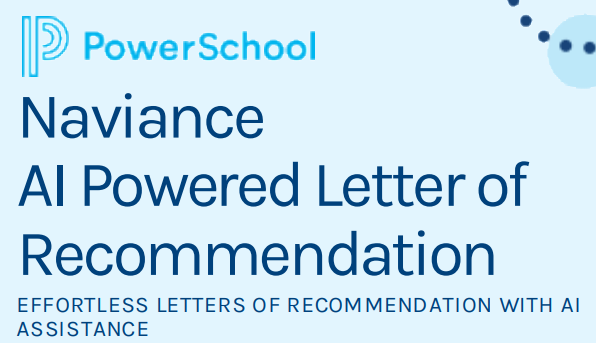
The integration of artificial intelligence into education reaches a deeply personal frontier with Naviance’s new AI-powered tool for teacher recommendations. As part of the Naviance College, Career, and Life Readiness platform, this feature aims to streamline the time-consuming process of writing letters of recommendation. However, its introduction has sparked a complex debate among students and educators, revealing deep concerns about authenticity, equity, and the very soul of the teacher-student relationship.
How the Tool Works:
The operational mechanics are straightforward. After a student submits a recommendation request, a teacher can utilize the AI within the “Teacher Desk” dashboard to compose a letter. The system automatically generates a draft by mining the student’s Naviance profile, which includes listed achievements, activities, and goals. This draft is intended as a customizable starting point; teachers can edit the content and adjust settings for tone and formality to ensure the final letter reflects their voice.
Student Reactions: A Chorus of Concern
The student response is overwhelmingly apprehensive, focusing on issues of fairness, authenticity, and the devaluation of their lived experiences.
Svar Pandya (‘26) delivered a comprehensive critique, arguing that AI fundamentally misunderstands the purpose of a recommendation. “I think it would be a lot more harmful for the students, considering that it just becomes your resumé all over again,” he said. He explained that while AI might highlight skills, “there is no way to capture the human-to-human interaction a teacher might understand over multiple years.” He pointed out a practical flaw: “A lot of things students ask teachers to write about in their recommendations aren’t in Naviance either, especially for activities that aren’t directly school-related.” Ultimately, Svar defined the core issue: “The whole point of a recommendation is that not everything about a student gets across on an admissions file… The admissions officers don’t personally know the applicant… they ask for other adults to extend their reach. Having AI do this off another paper can’t fulfill this purpose.”
Eric Chen (‘27) acknowledged the benefits and drawbacks of using AI in recommendation letter writing. “I think that using AI to write definitely makes rec letters easier for teachers who have so much to do already,” he noted, recognizing its efficiency. However, he also pointed out a key concern: “It takes away a lot of the personality and detail that you’re looking for from a rec letter.” Still, Chen viewed AI as a potentially valuable aid when used responsibly. “As long as teachers proofread, improve, and personalize it, it’s a great way to speed up the process and make a good outline,” he concluded.
Mara Anderson (‘26) strongly opposed the use of AI in college and scholarship recommendation letters, calling it “disrespectful” to students and the trust they place in their teachers. “Students place immense trust in the teachers they ask to be their recommenders, and they pick specific teachers for a reason,” she explained. For Mara, the value of these letters lies in their authenticity. “I decided to ask my recommenders because I believe they both have a good idea of who I am as a person and as a student,” she said. “AI doesn’t know who I am, what my hobbies and extracurriculars are, or what kind of student I am—my teacher does.” She also pointed out the inconsistency in teachers relying on AI for such an important task: “These are the same teachers who forbid AI to be used for their classwork because AI is not their original work. But then they’d let one of the biggest decisions of our lives depend on something that’s ‘not their own work.’” Concluding firmly, Mara emphasized that using AI would strip away “the personal aspect of the recommender’s opinion” that makes these letters meaningful.
Harish Chandar (‘26) called the practice “disingenuous,” arguing that “the nature of a recommendation letter is a teacher’s personal experience with a student beyond what shows up on their resumé.” While acknowledging that “it probably saves a lot of time for them,” he proposed a radical solution: mandatory disclosure. “If teachers do use it, there should be a flag that shows up to students that says something like this document was partially or completely generated by AI. Would you like to proceed with forwarding this letter to [intended recipient]?”
Tianqing Lei (‘26) expressed concern over the use of AI in recommendation letter writing, emphasizing the importance of authenticity and personal connection. “I think I would feel offended if my faculty writers resorted to AI to write my letter of recommendation,” she admitted, explaining that such letters should reflect a teacher’s genuine understanding of the student. “I believe they knew me best as a student, and the use of AI dismisses this personal perspective that colleges seek from these letters,” she added. Tianqing also worried about how AI-written letters might be perceived by admissions officers, noting, “Since these letters are reviewed by most, if not all, of the colleges I apply to, an AI letter might suggest that the teacher cares less about my application and negatively impact my score.”
Samantha Narchetty (‘26) offered a nuanced view, distinguishing between AI as a writer and AI as a tool. “I don’t think that teachers’ use of AI… is a good thing,” she began, noting the risk of admissions officers devaluing AI-written letters. However, she suggested a middle ground: “While AI as a writing tool, specifically to evaluate written pieces and provide feedback or serve as a more intelligent thesaurus, is a good way to leverage technology… AI’s ability to write sentences with substance is poor.” She concluded that AI should assist, not replace: “I think that perhaps an AI tool to make the writing process smoother, like being able to answer questions on what a good teacher recommendation letter should contain or provide suggestions on teacher-written letters, may be a good way to integrate AI.”
Teacher Perspectives: A Spectrum of Skepticism and Cautious Utility
IMSA educators’ responses range from outright rejection to cautious, limited acceptance, with universal concern about the tool’s limitations.
Profe Kaluza prioritized the personal touch, stating, “I only recently learned about the Naviance AI tools, and I wouldn’t feel comfortable using them to generate entire letters of recommendation.” Her method relies on direct student interaction: “I always like to ask students what they enjoyed about my class and what moments stood out to them.” While acknowledging the tool might help teachers with a high volume of requests, Profe Kaluza also raised a critical point about transparency, agreeing that “students should probably be able to see whether their teachers used AI in their letters or not.”
Dr. Trimm reported using AI not as the author, but as an organizational aid, highlighting a key distinction. “The Naviance AI tools tend to produce very general letters that don’t fully reflect a student’s individuality or personality,” he observed. He said to me, “I use the platform ChatGPT more as a writing aid to help organize certain sentences and ensure that my phrasing is good. This way, when I write the letters, they are personal and accurately represent who the students are.”
Dr. Ott, who gave a presentation on this topic during IMSA’s Inspire and Ignite Symposium on Friday, October 17th, said, “Naviance itself isn’t exactly an AI tool, but its letter-writing features definitely use generative technology. That changes what recommendation letters even mean. These letters used to reflect a student’s real character and performance, but if AI is now helping write them, we have to question their purpose. I don’t think AI can truly capture a student’s personality or the unique ways they interact in class. Not yet, at least. The writing it produces feels formulaic, and sometimes it even invents classroom moments that never happened.” She continued, “This technology could also pressure teachers who struggle with English or who have large workloads to depend on it for convenience. But that convenience comes at a cost. Teachers deserve to know how this system works, what data it uses, and how it’s trained. It’s concerning because now both sides of the college process might be using AI, teachers to write letters and admissions officers to read them, creating what feels like an AI loop.” “Transparency is another major issue,” Dr. Ott said. “Some of my former students told me they would feel betrayed if they found out a teacher used AI for their recommendation. I think students have a right to know whether AI was involved. At the same time, higher education needs to be clearer about what role these letters still play in applications.” She concluded, “In the end, it depends on how we view recommendation letters themselves. If they’re supposed to show a student’s individuality, AI simply can’t replace that. The real question is whether these letters are still the best way to represent student achievement in the first place.”
Dr. Kotlarczyk provided a philosophical analysis of modern writing, noting, “Writing today feels more like curation than creation.” He expressed clear empathy for the student perspective: “If I were a student, I’d be worried.” His critique centered on the unique value of a recommendation that AI cannot replicate: “Students ask teachers for letters that are personal and genuine. Colleges already have grades and resumés—they need to know who the student is as a person. AI can’t do that yet.” He also questioned the premise of saving time, asking, “If teachers are using it to save time, I’m not sure what they’re saving that time for, since writing recommendations is part of our job.”
Dr. Buck was the most unequivocal in his opposition. “I’m skeptical of this kind of technology and wouldn’t encourage others to use it. Writing letters personally is, and should continue to be, important,” he stated. He argued that AI cannot grasp human character because “it doesn’t actually know them.” He also identified a practical consequence: a loss of distinctiveness. “If even half of the recommendation letters start sounding the same, nothing will stand out anymore compared to the ones written by hand.” Regarding transparency, he was uncertain if students should know, musing, “Like with other tech trends, some people might lose interest in ChatGPT once something new comes along. Maybe we’re already seeing the AI bubble start to pop.”
Dr. Carlson cited a lack of awareness, saying, “I didn’t even know the Naviance AI tools existed.” His concerns focused on the data source, noting the tool pulls only from Naviance profiles, while “I prefer to write my own letters and look through each student’s resumé myself.” He conceded the tool might have utility when a student doesn’t provide a resumé, but ultimately critiqued its marketing: “If it’s being promoted as a time-saving feature, I think that sends the wrong message. At this point, it just can’t be fully trusted.”
The Fundamental Divide:
The feedback from students and teachers highlights a significant tension. While the Naviance AI tool is designed for efficiency, many stakeholders fear it undermines the essential purpose of a recommendation letter, which is to convey the authentic, personal connection between a teacher and a student. The strong consensus indicates that the heart of an effective letter must come from human experience. This includes unique personal insights, specific shared memories, and a deep understanding of a student’s character that cannot be automated. The central challenge is to determine if this technology can be ethically integrated as a supportive tool without eroding the personal nature of the college application process.
Sources
https://ps.powerschool-docs.com/naviance/latest/teacher-desk




Be the first to comment on "Naviance’s AI Recommendation Tools: Helpful Innovation or Human Replacement?"