
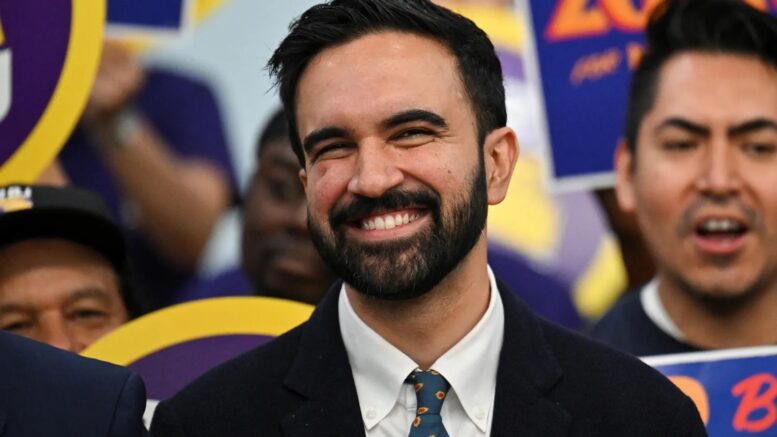
The most recent New York mayoral election took America by storm for its viral moments, rivalry between parties, and, most notably, the winner being America’s first ever South Asian, African American, Muslim mayor.
Zohran Mamdani is a person of diverse identity, being born in Uganda to parents of Indian descent. His parents differ in religion, his father being Muslim and his mother Hindu. Mamdani identifies as a Muslim South Asian and African American. His vast diversity attracted plentiful attention during the election, as he was one of the first non-white candidates to emerge as a top contender. Many of the people from communities he represented looked at him with a hopeful eye to become one of three people of color to hold office. Mamdani himself is an immigrant, as he moved to New York at the age of seven and has been living there since. His background in politics is sparse, especially considering his young age of 34. He graduated from Bowdoin College with a major in Africana Studies and a minor in Government in 2014.
However, he entered politics just 5 years ago, being an assemblyman in Queens for the 36th district. While in the assembly he often worked on issues concerning transit, housing, and rights for immigrants. Although some consider his experience to be lacking, his ambitious campaign was obviously effective enough to win the election.
However, it wasn’t just his background that earned Mamdani criticism throughout the election. Mamdani’s campaign was based on bold claims and the general idea of “serving New Yorkers.” His claims earned him the most doubt. He has presented progressive ideas such as lowering the cost of living through childcare and housing, freezing rent for rent stabilized apartments for four years, increasing corporate tax and tax on the rich, creating city-owned grocery stores, and making public buses free. Given his lesser experience in comparison to his opponents, many people are skeptical of how he will deliver on these promises. Critics have argued that his rent freeze plan will significantly hurt building owners by cutting into their operating income. Others reason that his idea for government-controlled grocery stores is a fantasy that ignores the realities and logistics of the food supply chain. Additionally, there has been disagreement between the Mamdani administration and the chair of the MTA (Metropolitan Transportation Authority) concerning how much it would cost the city to make buses free. Mamdani has presented a cost of around $630 million while the latter argues it would be closer to $1 billion.
Mamdani also didn’t shy away from honoring his identity and expressing his values, which hurt his chances in some cases. Throughout the election, he was extremely clear that he has no loyalty to Israel, even stating, “As mayor, New York City would arrest Benjamin Netanyahu. This is a city that our values are in line with international law.” His clear pro-Palestine assertion is especially risky given the division amongst our country. According to a 2024 Siena College poll, 43% of New Yorkers support US economic and military aid to Israel and the government is a reflection of this. According to a press conference statement made by Marco Rubio, the secretary of the state, the Trump Administration has approved around $12 billion to fortify “America’s long-standing commitment to Israel’s security.” Meanwhile, Mamdani has repeatedly stated his main focus is the people of New York.
To combat public skepticism, Mamdani was constantly seeking relationships with the local communities of New York. His constant presence on the streets with the New York community gave people reassurance about his genuine concern and commitment. He made many visits to mosques, churches, LGBTQ+ events, senior centers, and more. He often held “listening tours” (informal meetings) all throughout New York-in subways, parks, plazas, etc.- which invited many voices to be heard. Additionally, Mamdani and his team reportedly knocked on over 3 million doors throughout all five boroughs while canvassing. Mamdani made it clear he was passionate about hearing and delivering on what the people want.
This aspect of his campaign resonated strongly with young people, who saw him as offering a relevant and refreshing perspective, supporting him in large numbers.
According to exit polls, 75% of the youth population voted for Mamdani, meaning he had a strong presence within their community. Among young voters, those of color showed the most love to Mamdani, consisting of 85% latino and 83% Black while white youth voters comprised 62%. This level of support from youth seems to be coming from a place of hope. It has been a while since we’ve seen a candidate that earnestly spoke of issues and values that struck a chord with our age group. The outcome of the election proves that connecting to the youth of today is powerful and effective.
As a Muslim American myself, watching Mamdani win the election gives me added hope and confidence for my future. It is beyond inspiring to see a Muslim supported and respected enough to attain a position of such importance that many believe Muslims could never (or shouldn’t ever) hold. It proves the distorted lens people view Muslims through isn’t harsh enough to blind the genuine compassion of those who work hard to prove it.
Personally, however, I celebrate this election with slight hesitation. Mamdani represents a large population of Muslims, South Asians, and African Americans–a group that already receives enough scrutiny and distrust from a large part of America. Mamdani is being watched very closely by the public. He has stacked himself high with lavish promises and broad statements that leave him with a long way to fall. And if so, he will be dragging down a large community with him. Consequently, it is crucial that Mamdani maintains the trust of his voters, remaining an honest and true politician that is working with the best intentions: to better the lives of all New Yorkers.

Be the first to comment on "Mamdani Through My Eyes"