An Analysis of the Black Hole Mergers of 2025
Written By Pranshu Nautiyal
It’s a swirling hole in the abyss of space, taking everything inside it. Not even light can escape from this gaping monster. That is the cold reality behind the phenomenon known as black holes, which warp the fabric of reality. While black holes remain largely a mystery due to their difficult nature to observe, two astronomical events that took place this year have helped develop our understanding of them.
What Is a Black Hole?
Albert Einstein’s general theory of relativity, published in 1915, predicted that an object with a high enough mass would form a black hole. The heavy mass causes them to make a sizable indent on the plane of space-time. This makes light, which is massless and cannot be impacted by forces, curve around it. Einstein initially tried to deny the existence of black holes, calling them “outlandish”. However, other physicists at the time, like Robert Oppenheimer and George Volkoff, published papers using the general theory to predict their existence. In the late 1960s to early 1970s, more evidence came out to support the existence of black holes. Most notably, the first sign of a black hole was proven by Cygnus X-1, an X-ray source discovered in 1964.
Despite the many breakthroughs scientists have made, black holes remain largely a mystery. Scientists have found fewer than 100 black holes as of today (NASA). Many black holes are stagnant and do not emit radiation, leaving the only method to observe them as gravitational lensing.
Figure 1:
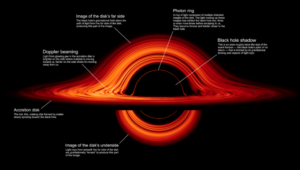
An artist’s illustration of a black hole. Key parts, like the accretion disk, are labeled.
Visual by NASA – https://svs.gsfc.nasa.gov/13326
Why Was the Two Black Holes Colliding Such a Big Deal?
When Einstein first did his calculations on black holes, he concluded that we would never be able to pick up on the gravitational waves left by them, nor would we ever see them collide. However, his claims were shattered by the black hole collision GW250114, which happened in January of 2025. These gravitational waves, measured by giant laser interferometers, told us useful information about the location and size of this collision. This collision was also important because it verified Stephen Hawking’s claims about the surface area of a black hole. However, the more significant black hole merger of 2025 occurred in June. GW231123 left astronomers with more questions due to its unique nature and size. The black holes that collided were spinning at around 40 times a second, and their sizes were supposed to be forbidden by the laws of stellar evolution. While these two collisions left us with some answers, they left us with a lot more questions.
Figure 2:
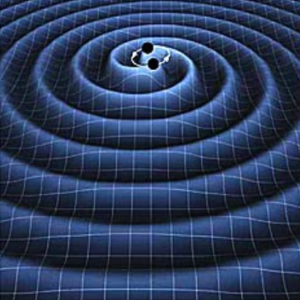
Two supermassive blackholes are colliding. Note the ripples in spacetime that occur due to their immense mass.
Source: HubbleSite: Black Holes – https://www.stsci.edu/~marel/black_holes/encyc_mod3_q6.html
Conclusion
Scientists were able to detect two black holes colliding twice this year, which left us with confirmation of Hawking’s theory, but also raised questions about how black holes can defy the laws of stellar evolution. Black holes as a whole are still a mystery, but the two collisions this year helped us as a human race move closer to the truth, not just about black holes but about the universe as a whole.
Works Cited
Black Holes – NASA Science. (2025). Retrieved from https://science.nasa.gov/universe/black-holes/
HubbleSite: Black Holes: Gravity’s Relentless Pull interactive: About This Site: Encyclopedia. (n.d.). Retrieved from https://www.stsci.edu/~marel/black_holes/encyc_mod3_q6.html
NASA Visualization Shows a Black Hole’s Warped World. (2023). Retrieved from https://www.nasa.gov/universe/nasa-visualization-shows-a-black-holes-warped-world/
Prisco, J. (2025). Black hole collision confirms decades-old predictions by Einstein and Hawking. Retrieved from https://www.cnn.com/2025/09/11/science/black-hole-collision-einstein-hawking