Quark Stars, the Theoretical Dense Relics of Stellar Collapse
Written by: Hari Ananthakrishnan
Introduction
As massive stars near the end of their lifespans, they collapse under the force of gravity and leave behind dense remnants, like white dwarfs or neutron stars. However, astrophysicists have theorized the possible existence of a stellar corpse even stranger than these–the quark star. These stars wouldn’t be made of neutrons, but the very particles that compose them, quarks, compressed into an ultra-dense state of matter. Although no quark star has been definitively observed, theoretical models as well as indirect evidence suggest that they may exist as an intermediate stage, separating neutron stars and black holes. In this article, we will explore the theoretical foundation of quark stars, examine their probable formation and characteristics, and view the current search for evidence of them.
Theoretical Foundations of Quark Stars:
Quark stars, as their name suggests, are rooted in the physics of quarks, the elementary particles that make up protons and neutrons. Under normal conditions, quarks are confined inside nucleons because of the strong nuclear force, a principle known as color confinement. However, confinement may break down at sufficiently high densities and pressures, like those found inside collapsed star remnants. When this happens, quarks are no longer bound into protons or neutrons; instead, they exist in a free-flowing state called quark matter.
Theoretical physics, specifically Quantum Chromodynamics (QCD), predicts that at extreme densities, quark matter could be energetically favorable compared to neutron matter. Essentially, under those conditions, it would require less energy for matter to exist as free quarks rather than tightly bound neutrons and show that quark matter would be the more stable state. In particular, scientists hypothesize the existence of “strange quark matter,” which includes up and down quarks (the building blocks of ordinary matter) as well as strange quarks. This phase could actually be more stable than nuclear matter itself, and potentially allow quark stars to persist for long periods of time.
Figure 1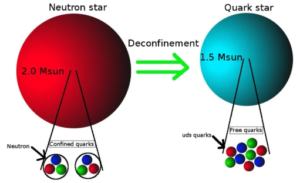
Size comparison of larger and less dense neutron star to smaller and denser quark star
Source: Matthew LeRoy
The Characteristics and Formation of Quark Stars
Quark stars are thought to form in environments of extraordinary density, even more extreme than those that produce neutron stars. When a massive star experiences a supernova explosion, its collapsing core may reach a point where neutrons themselves disintegrate into their constituent quarks. If this phase of deconfinement stabilizes, the result could be a quark star instead of a black hole.
Another possible way of formation is the conversion of neutron stars into quark stars. A neutron star that accretes matter from a binary companion might eventually surpass the threshold density for quark deconfinement. This would end up triggering a rapid phase transition and turn the dense neutron core into strange quark matter. Quarks are expected to be smaller and denser than neutron stars, around 10-16 kilometers in diameter in contrast to the typical 20-25 kilometers of a neutron star, while maintaining a mass that would be comparable to or greater than the Sun.
Furthermore, quark stars would possess some pretty unusual properties. Their densities may reach 10^15 grams per cubic centimeter, an order of magnitude beyond neutron stars. They might also lack a solid crust and consist entirely of deconfined quark matter. The conversion process itself could release large amounts of energy, making quark stars extremely luminous and hot for short periods after forming.
Figure 2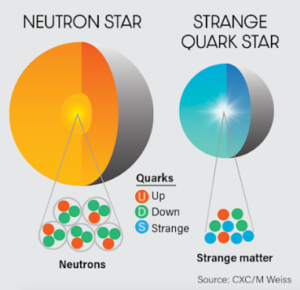
Composition comparison of neutron and quark stars
Source: CXC/M Weiss and Alison Mackey/Discover
Searching for Quark Stars
Direct detection of quark stars is challenging. They resemble neutron stars in many respects, because both are compact, dense, and emit strong radiation. However, scientists try to look for subtle differences in observational data in order to distinguish between the two. One approach is analyzing the mass-radius relationships of pulsars: If an observed star is significantly smaller for its mass than expected from neutron star models, it may indicate the presence of quark matter.
Gravitational wave astronomy could also be an option. When two neutron stars collide, the resulting gravitational waves encode information about the equation of the state of matter at extreme densities. Deviations from predictions that are based solely on neutron matter may hint towards the presence of quark matter inside the merging objects. Some researchers also study some unusual supernova events that release more energy than normal. These events could potentially be explained by neutron stars and their collapse into quark stars.
Lastly, astronomers investigate the cooling patterns of compact stars. Quark stars may cool at a different rate than neutron stars as a result of the distinct behavior of quark matter under extreme conditions. As the next generation of X-ray telescopes and gravitational wave detectors are improved, they will help provide the data needed to test the quark star hypothesis.
Figure 3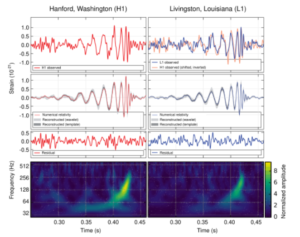
Measurement of the gravitational waves at the Livingston (right) and Hanford (left) detectors at LIGO, compared with theoretical predicted value.
Source: B. P. Abbott et al. (LIGO Scientific Collaboration and Virgo Collaboration)
Conclusion
Quark stars are some of the most intriguing theoretical objects in modern astrophysics; if confirmed, they would represent a completely unique state of matter where the very building blocks of protons and neutrons flow freely under unimaginable pressure. Their significance is not limited to astronomy as well. They are natural laboratories for testing fundamental physics in conditions impossible to reproduce on Earth yet. Moreover, they could also provide answers to questions about the life cycle of massive stars and the behavior of matter at its ultimate limits. As technology advances, the search for quark stars may deepen both our understanding of both the cosmos and the fabric of matter itself.
References and Sources
Cain, F. (2016, July 25). What are Quark Stars? Universe Today. Retrieved from
https://www.universetoday.com/articles/what-are-quark-stars
Biology Insights. (2025, August 30). What Is a Quark Star and How Does It Form? Biology
Insights. Retrieved from https://biologyinsights.com/what-is-a-quark-star-and-how-does-it-form/
Sentinel Mission. (2025, August 12). Quark Star – Definition & Detailed Explanation –
Astronomical Objects Glossary. Sentinel Mission. Retrieved from
https://sentinelmission.org/astronomical-objects-glossary/quark-star/
SciSimple. (2025, June 17). Quark Stars: The Dense Mysteries of the Universe. SciSimple.
Retrieved from
https://scisimple.com/en/articles/2025-06-17-quark-stars-the-dense-mysteries-of-the-univ
erse–a315j7x