Growing Organs with Electricity
Written by: Jonathan Handjojo
In the future, waiting for an organ transplant might sound as outdated as using dial-up internet. Every day, 17 people in the U.S. die waiting for an organ that never comes, and more than 100,000 are left wondering if their life-saving treatment will ever come. Prosthetics have improved, but they still can’t restore full sensation or motion. Instead of replacing what’s lost, what if medicine could grow it back?
This is the goal of bioelectric medicine, a field that uses small electrical signals to guide how cells grow, heal, and organize into tissues. The idea seems counterintuitive: healing wounds and regenerating organs not with surgery or drugs, but with tiny pulses of electricity. At the core of every heartbeat, muscle twitch, and thought, electricity keeps the body alive, and learning to control it could mean learning new ways to heal.
How Cells Use Electricity
Every cell in the body carries a voltage that is generated by the movement of charges through channels in its membrane. Together, these voltages tell cells where they are, what they should become, and how to work together. During development, electrical signals help define left from right, head from tail, and limb from torso long before the brain even forms.
Scientists have found that these patterns are a bioelectric code, a program that controls the body’s architecture. Here, DNA gives us “a parts list”, but electricity gives us instructions for how to assemble them. By altering the electrical environment around cells, scientists can change how they behave. Stem cells can be encouraged to become muscle or nerve tissue. Damaged skin can heal faster. In animals, even some complex structures like limbs can regrow.
Figure 1
Schematic illustration of an electroactive scaffold to induce bone regeneration.
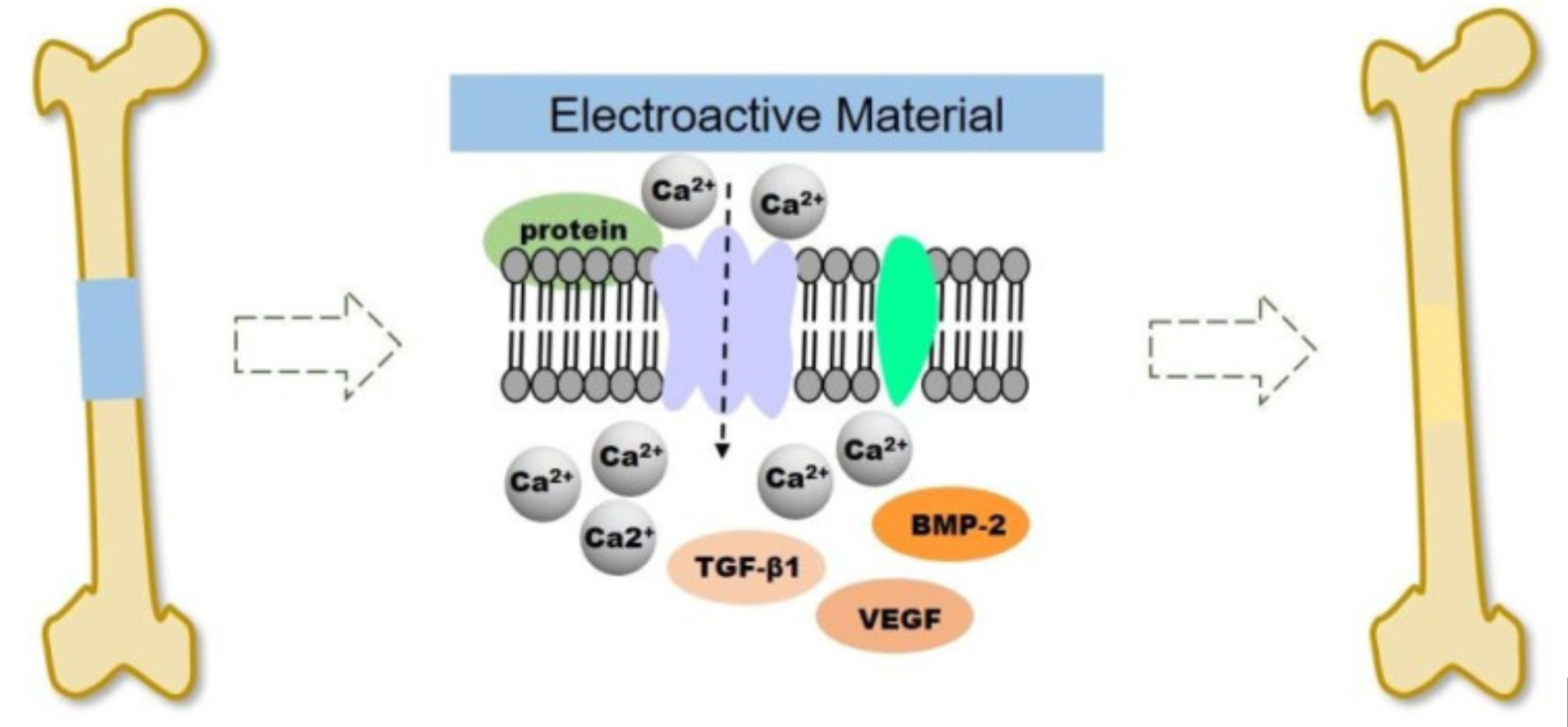
Source: Bandung Institute of Technology
Reprogramming the Body’s Blueprint
Researchers studying bioelectricity at Tufts University discovered that certain flatworms could regenerate entire bodies from small parts. When scientists changed their electrical networks, the worms regenerated with two heads instead of one. Even after being cut again, both heads regrew, showing that the tissue had “remembered” a new pattern.
This indicates that cells store memories of shape, where electrical instructions defining this shape can be updated, like rewriting software. When similar ideas were applied to frogs, scientists were able to stimulate leg regeneration using a small bioreactor that delivered specific electrical cues to the wound. The cells didn’t need any genetic editing, but simply followed their electrical instructions.
Electric Healing Potential
Electrical stimulation isn’t new. Defibrillators and pacemakers already keep hearts beating, but using electricity to control growth is a technique that has never been implemented before. By mimicking natural bioelectric patterns, scientists can make cells behave as if they are still developing, allowing them to rebuild tissue instead of scarring over.
The potential applications are enormous. Damaged spinal cords could reconnect their nerves. Burn victims might regrow skin without painful grafts. Even brain tissue lost to injury or disease could be rebuilt using voltage patterns that tell neurons where to grow. Because these signals can be applied externally and adjusted precisely, bioelectric therapy could one day offer a non-invasive way to regenerate organs from within.
Figure 2
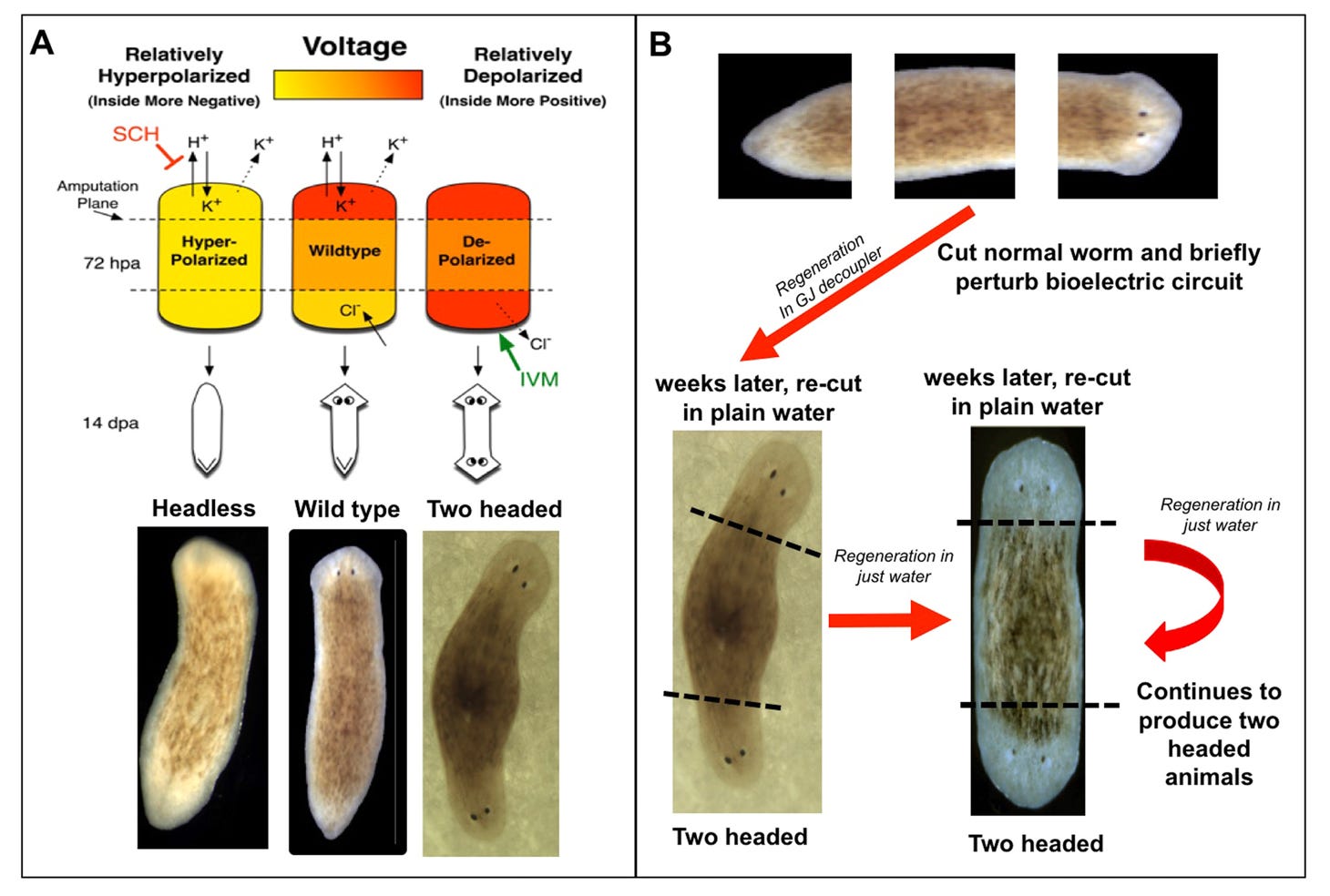
Normal flatworm regrowing 2 heads.
Source: Tufts University
The Challenges Ahead
However, the science is still young. Human tissues are more complex than those of frogs or flatworms, and the bioelectric code varies between species. Delivering precise electrical signals deep inside the body is also difficult. Too much stimulation can damage cells; too little has no effect. Researchers are also mindful of the ethical implications, deciding where to draw the line between repairing biology and redesigning it. Should we really be designing tissues with new shapes, functions, or abilities beyond what the human body could naturally produce, such as designing organs that filter toxins more efficiently than kidneys, or is it too far?
Still, scientists are optimistic as experiments show that the same principles guiding a tadpole’s tail could guide human cells, too. If this technology matures, patients may no longer rely on donors or artificial implants. Instead, doctors could “program” the body to heal itself, using electricity to spark regeneration the same way nature once did.
Conclusion
Electricity has always powered our world, and now, it may power our healing. By decoding the bioelectric signals that shape life, scientists are learning how to regrow tissue, repair organs, and one day restore entire limbs. Bioelectric medicine is a new language for biology, one that could transform how we recover and lead to evolution.
References and Sources
Brownell, L. (2019, July 26). Electrifying insights into how bodies form. Harvard Gazette. https://news.harvard.edu/gazette/story/2019/07/wyss-researchers-has-electrifying-insights-into-how-bodies-form/
How bioelectricity could regrow limbs and organs: Big Brains podcast with Michael Levin | University of Chicago News. (2023, April 27). News.uchicago.edu. https://news.uchicago.edu/how-bioelectricity-could-regrow-limbs-and-organs
Marsudi, M. A., Ariski, R. T., Wibowo, A., Cooper, G., Barlian, A., Rachmantyo, R., & Bartolo, P. J. D. S. (2021). Conductive Polymeric-Based Electroactive Scaffolds for Tissue Engineering Applications: Current Progress and Challenges from Biomaterials and Manufacturing Perspectives. International Journal of Molecular Sciences, 22(21), 11543. https://doi.org/10.3390/ijms222111543
Zheng, T., Huang, Y., Zhang, X., Cai, Q., Deng, X., & Yang, X. (2020). Mimicking the electrophysiological microenvironment of bone tissue using electroactive materials to promote its regeneration. Journal of Materials Chemistry B, 8(45), 10221–10256. https://doi.org/10.1039/d0tb01601b