The Effect of the Human Subconscious on Behavior and Decision Making
Written by: Meghna Manoj
Introduction: unconscious connections in human interactions
The human unconscious mind starts thinking and affecting decision making processes before humans realize that they’re thinking at all. A research paper published with the National Library of Medicine confirms, saying the “actions of an unconscious mind precede the arrival of a conscious mind—that action precedes reflection” (Bargh & Morsella, 2008). Unconscious connections are the involuntary conclusions that the human mind creates between concepts or people as a result of beliefs, experiences, or other factors. Many notable studies and discoveries have been conducted on the topic of the subconscious mind and the connections it makes throughout history, including by Sigmund Freud, an Austrian neurologist from the late 19th and early 20th century, who used techniques like dream analysis and free association to uncover hidden memories, repressed feelings, and unconscious influences on conscious behavior. These connections are extremely relevant to everyday human interactions and behavior, and the creation of such connections by the brain happens as a result of complex biological processes.
The brain’s structures and systems
Connections are formed in the brain by the creation of neurons, and synaptic connections between nearby neurons. After these brain cells are created through proliferation, or division and multiplication, of existing cells, they migrate to their predetermined position in the brain, guided by chemical signals. Each neuron is composed of 6 main parts, the cell body (or soma), which includes the nucleus, responsible for controlling cell activities and directing proliferation, and dendrites, which receive electrical signals from other neurons. They also have axons, the long stems connecting the receiving and transmitting end of the neuron; and the axon terminals, which transmit chemicals called neurotransmitters to the synaptic clefts (on the dendrites) of another neuron, telling it whether to continue or stop transmitting. If the neuron continues to transmit the signal, the attachment of the neurotransmitter by the synaptic clefts, the microscopic gaps where a nerve impulse is emitted by neurotransmitters, of the new neuron reactivates the electrical signal for transmission to the rest of the pathway.
Figure 1
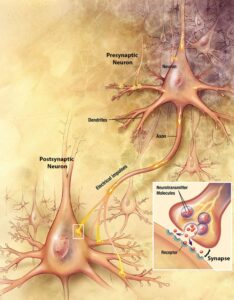
Electrical signal traveling between neurons
Source: M. T. Owens and K. D. Tanner in “Teaching as Brain Changing: Exploring Connections between Neuroscience and Innovative Teaching”, article on Pub Med Central in National Library of Medicine
When humans make connections between people or ideas, the brain makes and modifies a network of interconnected neurons that fire together to convey a message to a part of the brain. The brain’s ability to change and form new connections, even after it gets hurt, is called neuroplasticity which lets the brain adapt by restructuring its neurons and building new pathways. Kimberly McAllister, a Professor of Psychology and Computer Science and Ph.D., states, “During [human] development, the 100 trillion synapses in the human cortex form at a rate of an estimated 10,000 every 15 minutes!” (McAllister 2023). As a result, the first few years of life, where experiential learning and absorption of information are at their highest, are a crucial period in brain development and the creation of neural pathways, but neuroplasticity continues throughout life.
Methods and mechanisms of subconscious development
The subconscious mind is developed through implicit learning, where the individual is not aware of their absorption and processing of information. In this way, reinforcement and reward feedback plays a large role in shaping behavior and building unconscious habits and associations.
Figure 2
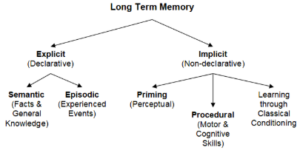
The difference between explicit and implicit types in long-term memory
Source: M S S El Namaki in “Could Business Organizations Simulate the Brain’s Implicit Learning Process? And Apply That to Strategic Thinking?”, report in the International Journal of Management and Applied Research
A comparative study conducted by Leonora Wilkinson and Marjan Jahanshahi investigated which parts of the brain were involved in implicit learning by evaluating the learning of different concepts shown during the study in patients with Parkinson’s, specifically looking at the parts of the brain affected by the neurodegenerative disorder. Essentially, both the group with Parkinson’s and the control group used “probabilistic implicit sequence learning”, which means that they learned the given topics through reinforcement, through being exposed to it many times, but also without realizing that they were absorbing and processing information. They also learned it concurrently with another task, with “measures of priming and recognition” obtained “concurrently” (Wilkinson & Jahanshahi, 2006).
Additionally, the study also supports how different parts of the brain are used for different types of learning, with the basal ganglia contributing to probabilistic implicit sequence learning. The basal ganglia, a sprout-like structure in the center of the brain, is involved in motor control, but is also essential for learning, memory, emotion, and reward-based behaviors, and is a part of the brain affected by Parkinson’s disease. As “The neural correlates of implicit and explicit sequence learning: Interacting networks revealed by the process dissociation procedure”, an article in the NIH confirms, “it is worth pointing out that many other regions have been described as being concurrently associated with implicit and explicit learning, including cuneus and precuneus, cingulate, parietal and frontal areas, thalamus, insula, media temporal regions, and cerebellum” (Destrebecqz et al., 2005).
Conclusion: Implications of the subconscious
In an everyday context, humans use their subconscious mind for a wide variety of functions, from simply storing implicit memories and knowledge to handling involuntary actions or affecting behavior and decision making. Humans also use their past learned behaviors in complex situations, or for responding to social stimuli. However, the subconscious mind also enables biases, prejudices that shape perceptions, and while they’re natural, they can lead to issues when resultant behavior affects interactions (Neuroba, 2025). Unconscious biases are present throughout everyday human behavior, and moderating the usage of unconscious biases to ensure only positive outcomes occur is essential, especially in today’s tumultuous society. Biases can represent themselves as stereotypes, or even as results of first impressions. Furthermore, subconscious learnings can appear through emotional impacts, like empathy, when ideas taken from past experiences allow an individual to have different emotions or emotional resonance towards another. In summary, the synaptic connections between neurons in different parts of the brain allow humans to make subconscious connections between ideas and people, and to implicitly learn, affecting everyday decision making and behavior.
References and Sources
Bargh, J. A., & Morsella, E. (2008, June 26). The unconscious mind. PMC Home – NIH.
https://pmc.ncbi.nlm.nih.gov/articles/PMC2440575/
Destrebecqz, A., Peigneux, P., Laureys, S., Degueldre, C., Del Fiore, G., Aerts, J., Luxen, A.,
Van Der Linden, M., Cleeremans, A., & Maquet, P. (2005). The neural correlates of
implicit and explicit sequence learning: Interacting networks revealed by the process
dissociation procedure. PMC Home – NIH.
https://pmc.ncbi.nlm.nih.gov/articles/PMC1240060/
IJMAR. (n.d.). Implicit and Explicit Memory [Diagram]. International Journal of Management
and Applied Research. https://www.ijmar.org/v7n1/20-005.html
McAllister, K. (2023, January 23). Making and breaking connections in the brain. UC Davis
Center for Neuroscience.
https://neuroscience.ucdavis.edu/news/making-and-breaking-connections-brain
Neuroba. (2025, January 13). Understanding the subconscious mind and its impact on behavior.
https://www.neuroba.com/post/understanding-the-subconscious-mind-and-its-impact-on-
behavior-neuroba
Owens, M. D., & Tanner, K. D. (2017). Teaching as brain changing: Exploring connections
between neuroscience and innovative teaching. PMC Home – NIH.
https://pmc.ncbi.nlm.nih.gov/articles/PMC5459260/
Wilkinson, L., & Jahanshahi, M. (2006, December 22). The striatum and probabilistic implicit
sequence learning. PMC Home – NIH. https://pubmed.ncbi.nlm.nih.gov/17229409/