A Simple Introduction to Quantum Computing
Written By: Jaylin Park
What’s the Deal with Quantum Computing?
Quantum computing is a topic that has been receiving greater attention lately from both computer scientists and the public. Its capabilities are unparalleled, and it is slowly becoming a scientific reality. Unlike regular computers that we use today, quantum computers use qubits (quantum bits) instead of bits. This makes the quantum computer’s ability to calculate and contain information amplified by an exponential amount. Therefore, this new technology can drastically change and revolutionize fields like healthcare and finance. But how does quantum computing work? How can it affect our world? And what will it be able to accomplish in the future?
Quantum Computing, and How It Works
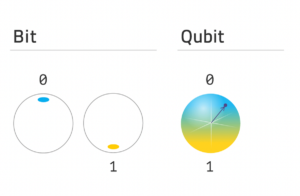
Unlike a traditional computer, which uses bits to perform computations and store information, quantum computers use quantum mechanics. Quantum mechanics is the science that deals with the behavior of light and matter at a scale smaller than an atom to process information. It explains how qubits can exist in a state of 0, 1, or both at the same time, as shown in Figure 1. This allows quantum computers to solve certain complicated and large problems much faster than an ordinary computer could. The reason for a quantum computer’s exceptional speed is because it has the ability to encode multiple probabilities in a state at once and extract results through measurement. The fact that these computers can compute computations that “would have taken traditional computers eons (Fitch, 2025)” in a short amount of time describes how much quicker they are.
Figure 1
The difference between a regular bit and a qubit is shown. A bit can only either be a 0 or 1, while a qubit can be either, or both at the same time.
Source: [Medium]
How It Is Affecting Our World Today
Quantum computing is not yet changing our daily lives or revolutionizing industries like AI is. However, it is beginning to impact research and industry. Research and development on quantum computing is increasing as businesses and companies are hoping to use its capabilities soon. For example, large companies like Google and Amazon have “announced their own quantum chips (Lin, 2025)” already. Its technology also has amazing potential in industries like healthcare and cybersecurity. For example, its ability to accurately simulate molecules and chemical reactions can help develop drugs and new treatments. There are many things that quantum computing can accomplish quicker and better than normal computers, but the field is not yet at the stage where it is becoming a big part of various industries.
What does the Future of Quantum Computing Look Like?
Quantum computing was once considered purely theoretical. It was thought to be too fragile or difficult to be used. However, as mentioned already, it is being developed, and has potential to drastically change medical and financial industries (to name a few) with its computing abilities. For example, through quantum cryptography, cybersecurity can be improved. A similar shift happened with artificial intelligence, as it was also said to be far from reality, but it has become a big part of many people’s lives with significant impact. Despite this progress, quantum computing still has a long way to go, and it will be difficult to be able to use it in everyday life. The fact that “qubits need to operate at temperatures near absolute zero (Fitch, 2025)” already presents an obstacle to using this technology widely. But who knows? Just like AI, it may become life-changing technology sometime in the near future.
References and Sources
Deutsch, D. (n.d.). Quantum computing – Wikipedia. Wikipedia, the free encyclopedia. Retrieved September 7, 2025, from https://en.wikipedia.org/wiki/Quantum_computing
Fitch, A. (2025, February 25). What Is Quantum Computing, and Why Does It Matter? The Wall Street Journal. https://www.wsj.com/tech/what-is-quantum-computing-explained-75c34d6e?msockid=098be5110a3f6da614ddf30c0b166c11
IEEE Computer Society. (2024, February 23). The Current State of Quantum Computing. https://www.computer.org/publications/tech-news/research/current-state-of-quantum-computing
Introduction to Quantum Information Science. (n.d.). 13.1 The three-qubit code | Introduction to Quantum Information Science. Retrieved September 7, 2025, from https://qubit.guide/13.1-three-qubit-code
Lin, B. (2025, March 12). D-Wave Claims ‘Quantum Supremacy,’ Beating Traditional Computers. The Wall Street Journal. https://www.wsj.com/articles/d-wave-claims-quantum-supremacy-beating-traditional-computers-155ca634?msockid=098be5110a3f6da614ddf30c0b166c11
Quantum mechanics – Wikipedia. (n.d.). Wikipedia, the free encyclopedia. Retrieved September 7, 2025, from https://en.wikipedia.org/wiki/Quantum_mechanics